
Typing Speed Percentile Chart: Are You in the Top 10%?
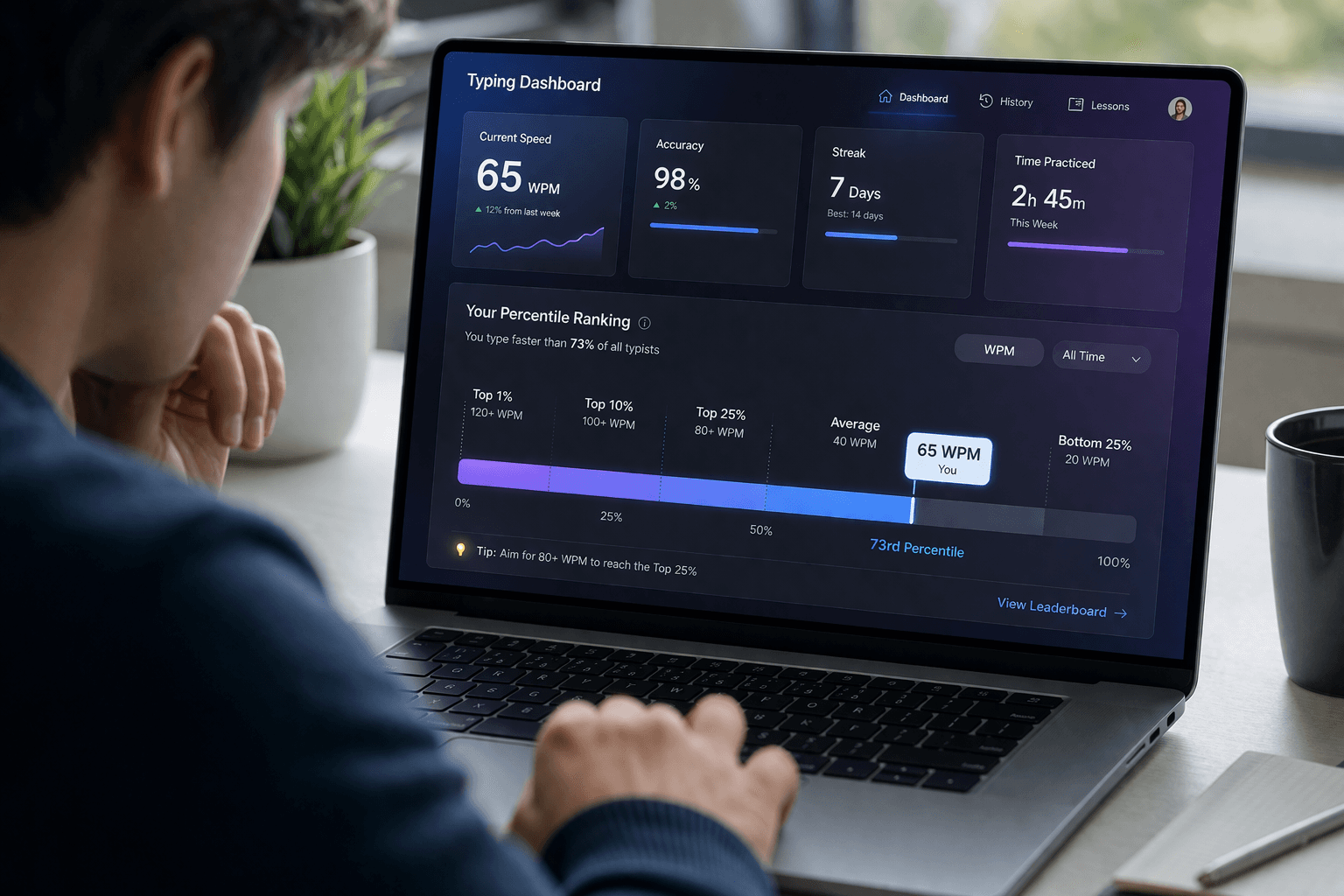
Knowing your WPM is useful. Knowing where that WPM places you among all typists worldwide is genuinely motivating — especially when you realize how achievable the top 25% actually is with a few weeks of focused practice.
The data below is drawn from aggregate typing test results across millions of users. The global median sits around 44–46 WPM, which is lower than most people expect. That means if you are already typing at 55 or 60 WPM, you are already faster than the majority of people who sit at a computer every day.
Typing Speed Percentile Chart
| Percentile | WPM Range | What This Means |
|---|---|---|
| Bottom 10% | 0–20 WPM | Very limited keyboard experience |
| 10th–25th | 21–35 WPM | Beginner typist, hunt-and-peck |
| 25th–50th | 36–45 WPM | Below average, casual daily use |
| 50th (median) | 44–46 WPM | Exactly average globally |
| 50th–75th | 46–65 WPM | Above average, solid office typist |
| 75th–90th | 65–80 WPM | Fast typist, professional level |
| 90th–95th | 80–95 WPM | Very fast, competitive range |
| 95th–99th | 95–120 WPM | Elite typist |
| Top 1% | 120+ WPM | Expert/competitive level |
One important caveat: these numbers reflect typing on a standard keyboard under timed test conditions. Your speed in a real document or chat window is typically 10–15% lower than your peak test speed due to thinking, pausing, and composing on the fly. Keep that gap in mind when evaluating where you actually perform day-to-day.
What Each Tier Means for Your Career
The percentile chart is not just a vanity metric — different career paths have different requirements, and knowing where you sit relative to those requirements matters.
Bottom 25% (under 36 WPM): At this level, slow typing is a meaningful productivity bottleneck. Emails, reports, and data entry take noticeably longer than they should. If your work involves regular keyboard use, improving to at least 45 WPM would be a worthwhile investment.
25th–50th percentile (36–45 WPM): This is where the average office worker sits. Functional, but not a speed advantage. Most basic administrative job postings require at least 40 WPM, so this range keeps you eligible but not competitive.
50th–75th percentile (46–65 WPM): Above average and professionally useful. At 55–65 WPM, you meet or exceed the requirements for most office, customer service, and entry-level data entry roles. This is a comfortable professional speed for most jobs that involve writing or documentation.
75th–90th percentile (65–80 WPM): This is where typing becomes a genuine competitive advantage on a resume. Roles in transcription, medical documentation, legal work, executive assistance, and high-volume data entry either require or strongly prefer speeds in this range. At 70 WPM, you are faster than nine out of ten people.
Top 10% (80–95 WPM): At this level, typing speed opens specific doors: professional transcription, real-time captioning support, court reporting (which typically requires 200+ WPM on a stenotype machine, but the keyboard path starts here), and competitive freelance typing roles. Employers notice this speed, and it is worth highlighting on a resume with a verified certificate.
Top 5% (95–120 WPM): At this level, you are significantly faster than almost everyone you will encounter in a professional setting. The productivity advantage is real: a person typing at 100 WPM produces first drafts, responses, and documentation at roughly twice the rate of someone at 50 WPM.
Top 1% (120+ WPM): Competitive typist territory. At this level, speed is no longer a practical bottleneck in any profession — it becomes a hobby, a competition, or simply a point of pride. Reaching this tier requires years of deliberate practice and excellent technique, but it is not necessary for any standard professional goal.
What It Takes to Reach Each Tier
Moving from bottom 25% to top 50% (36 → 45+ WPM): This is one of the most achievable jumps in the chart. Two to four weeks of structured daily practice — even just 15 minutes a day — is enough for most people to cross the median. The key is switching to proper touch typing technique if you have not already. Hunt-and-peck has a hard ceiling somewhere around 40–50 WPM for most people.
Moving from top 50% to top 25% (45 → 65+ WPM): Requires learning and ingraining touch typing, with four to eight weeks of deliberate practice. Most people who commit to this goal reach it within two months. This is the tier most professional job postings are looking for.
Moving from top 25% to top 10% (65 → 80+ WPM): This jump takes more time — typically two to four months of consistent training. Accuracy becomes critical here. At 80 WPM, your net speed after error penalties needs to be clean. Sloppy speed with frequent corrections does not count.
Moving from top 10% to top 1% (80 → 120+ WPM): This is where the diminishing returns become significant. Progress slows, the training becomes more specialized, and the time investment is substantial. Most professionals do not need to reach this level and should focus their energy elsewhere once they have cleared 80–90 WPM.
The Accuracy Factor
Raw WPM is only part of the picture. Typing tests and employers measure net WPM — which deducts uncorrected errors. Here is how the math works: if you type 80 WPM with 95% accuracy in a 1-minute test, you have approximately 4 errors, which deducts 4 WPM for a net score of 76 WPM. At 90% accuracy, you are losing 8 WPM — bringing an 80 WPM typist down to 72.
The practical implication: if you are trying to break into a higher percentile tier, improving your accuracy from 92% to 97% is often faster than trying to push your raw speed up by 5 WPM. Accuracy-first training — deliberately slowing down until errors drop, then rebuilding speed — is the most reliable path to a higher net score.
Factors That Affect Where You Land
Several things influence typing speed beyond just practice time:
Keyboard type. Mechanical keyboards with tactile or linear switches tend to produce slightly higher speeds for most typists. The feedback and key travel reduce typing errors compared to flat laptop keyboards. That said, some of the fastest typists in the world use standard membrane keyboards, so this is not a prerequisite.
Age. Younger learners tend to pick up touch typing faster due to neuroplasticity advantages. Adults learn touch typing perfectly well, but the consolidation phase — where muscle memory locks in — takes slightly longer. Adults who started typing young and built bad habits also tend to have a harder time unlearning them.
Profession and daily exposure. Writers, coders, journalists, and customer support agents who type thousands of words a day naturally build speed faster than people who use a keyboard occasionally. Daily high-volume typing is the single biggest predictor of long-term speed improvement.
Consistency of technique. People who use all ten fingers with proper home row positioning consistently outperform people who use seven or eight fingers with inconsistent placement. Technique matters more than raw effort.
Where Do You Currently Rank?
Take a free timed test right now to find your exact WPM and see exactly where you sit on the chart above. Once you know your baseline, you will have a clear target for your next tier — and a concrete goal to train toward.
About the author
Louis
Louis is a developer and productivity tools creator who built Typingverified to help professionals build verifiable typing skills. He writes about typing techniques, productivity, and keyboard ergonomics based on hands-on testing and research.
Email: support@typingverified.com
More articles
The Complete Beginner's Guide to Touch Typing in 2026 (Start to Certificate)
Everything you need to know about learning touch typing in 2026, from your first home-row practice to earning a professional typing certificate.
Typing Wrist Pain: What Causes It and How to Type Without Hurting Yourself
Wrist pain from typing is preventable. Learn the real causes of typing-related wrist pain and the setup, technique, and stretching fixes that actually work.
30 Typing Practice Sentences That Will Improve Your WPM Fast
Looking for typing practice sentences that actually improve your speed? Here are 30 carefully chosen sentences targeting accuracy, speed, and common word patterns.