
30 Typing Practice Sentences That Will Improve Your WPM Fast
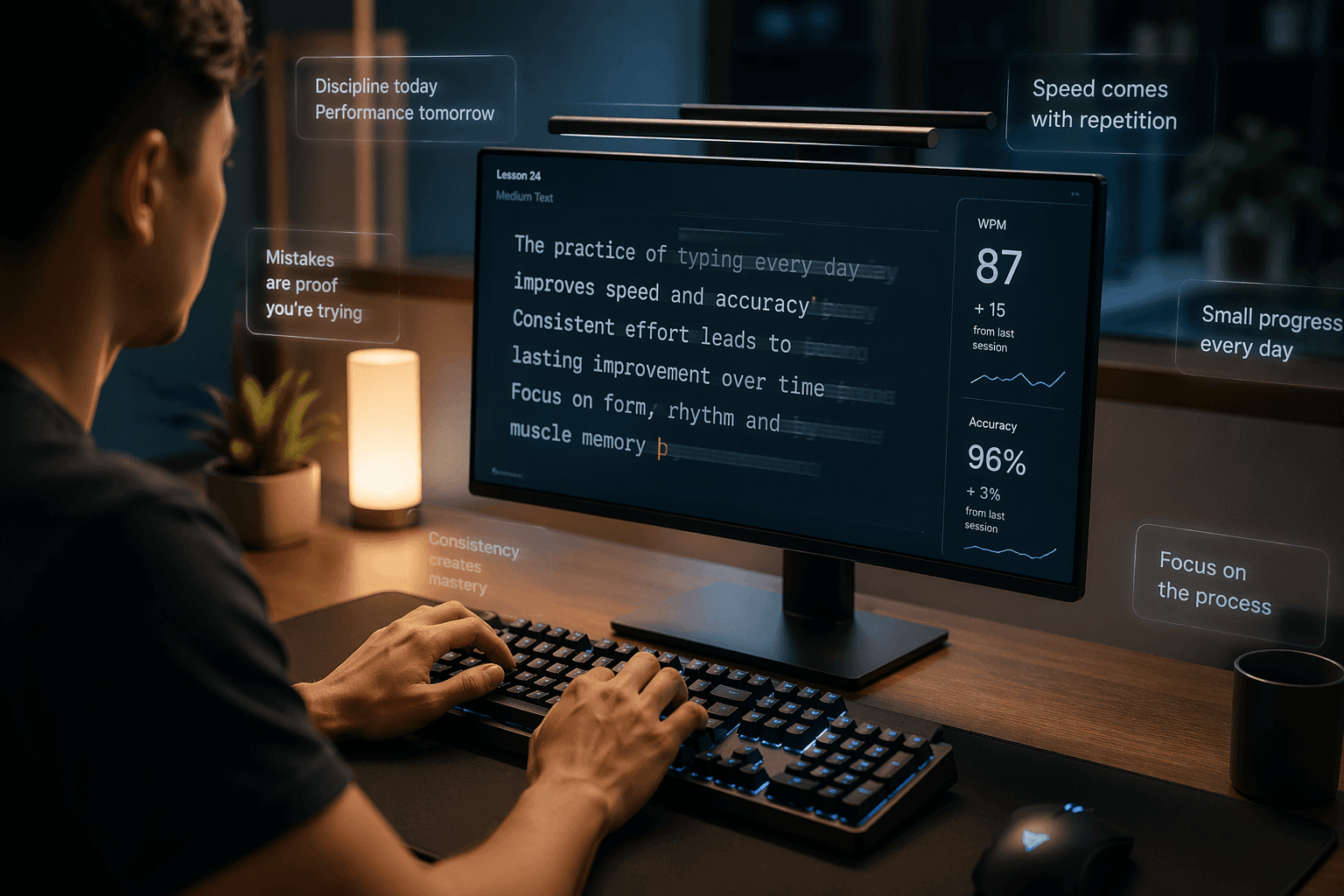
Not all practice text is equally useful. Random word generators build basic finger familiarity, but they do not replicate the patterns that slow you down in real typing. Targeted practice sentences — chosen for specific letter combinations, common word structures, and keyboard row coverage — build speed far more efficiently because they put stress on exactly the spots where most typists lose time.
The sentences below are organized by focus area. Each category targets a different aspect of keyboard performance. Work through them in order for a complete session, or pick a single category to drill the specific weakness you have identified in your error patterns.
Home Row Focus
The home row — A, S, D, F, J, K, L, semicolon — is where your fingers should rest between keystrokes. Building fluency here creates the foundation for everything else. If your hands are drifting away from home row during practice, these sentences will expose that immediately.
- "Ask a glad lad; a salsa flask falls."
- "Dallas flags a glass flask as a half-full hall."
- "Shall a lad add a sad fall salad?"
Drill these slowly first. The goal is not speed — it is accurate home row positioning on every keystroke.
Top Row Focus
The top row — Q, W, E, R, T, Y, U, I, O, P — contains many of the most common letters in English, including E, R, T, and O. Weakness here slows down virtually every sentence you type.
- "We require quiet poetry to write true stories."
- "Your power over poetry will tower over our prior work."
- "Terry wrote out every word with quiet power."
Full Keyboard Warm-Up
These classic pangrams — sentences that use every letter of the alphabet — are useful warm-ups because they force your fingers to cover the entire keyboard in a short sequence.
- "The quick brown fox jumps over the lazy dog."
- "Pack my box with five dozen liquor jugs."
- "How vexingly quick daft zebras jump."
Use these at the start of any practice session to activate all fingers before moving to more targeted drills.
Common Word Speed Drills
The highest-frequency words in English — the, be, to, of, and, a, in, that, have, it — account for a disproportionate share of everything you type. Fluency with these patterns alone will raise your WPM noticeably, because these words appear constantly and your fingers should execute them automatically.
10. "They have been there before and will be there again." 11. "We could not find the time to get the right answer." 12. "It would be good to know what you think about this."
Punctuation Integration
Most typing tests and real-world documents include punctuation, but many typists only practice clean word sequences. Adding punctuation to your drills builds the rhythm of pausing, shifting, and continuing — a different motor skill from pure word flow.
13. "Wait - are you sure? Yes, I am absolutely certain." 14. "Send the file (version 3.2) to John by Friday, March 28." 15. "She said: 'I'll be there at 9:00 AM, without fail.'"
Pay attention to the shift key transitions here. Most punctuation errors happen at the shift-hold-release point.
Accuracy Focus (Longer, More Complex)
Longer sentences require you to sustain concentration across more characters without losing accuracy. This is closer to what real professional typing looks like — not bursts of short words, but extended text with varied vocabulary.
16. "Professionals who type quickly and accurately have a significant advantage in the modern workplace." 17. "The development of keyboard proficiency is a skill that compounds over time with consistent practice." 18. "Accurate typing is not simply about speed - it is about producing clean, usable output on the first attempt."
For these, target 97%+ accuracy even if it means slowing down significantly. Accuracy first.
Speed Burst Sentences (Short, Common Words)
Short sentences made of high-frequency, short words are excellent for speed intervals — brief bursts where you push your pace before returning to your accuracy rhythm. They are also good for building confidence because the words are simple and predictable.
19. "Go to the top and look for the best." 20. "Take the time to do it right the first time." 21. "Get the file, send the note, and close the deal."
Number and Symbol Practice
Numbers and symbols are the most commonly avoided part of typing practice — and the most commonly slow. Real documents include invoice numbers, percentages, dates, and formulas. If you only ever practice plain text, you will slow to a crawl whenever a number appears.
22. "Invoice #2047 - Due: April 15, 2026 - Total: $3,482.00" 23. "The formula is: (A + B) x C / D = E" 24. "Call us at (800) 555-0192 between 9 AM and 5 PM EST."
Career-Specific Practice (Professional Tone)
These sentences replicate the language patterns of professional workplace communication — the kind of text you actually produce in emails, reports, and meeting notes. Practicing with realistic professional content builds fluency that transfers directly to your job.
25. "Please find the attached document for your review and approval." 26. "I am writing to confirm our meeting scheduled for Thursday at 2:30 PM." 27. "The report indicates a 12.4% increase in output during the third quarter."
Sentence Variety for Advanced Typists
These longer, more complex sentences are designed for typists already operating above 65 WPM who want to build consistency at higher speeds. They include varied vocabulary, punctuation, and rhythm changes that prevent autopilot.
28. "Ambiguity in written communication leads to misunderstanding and wasted time - clarity is always worth the extra effort." 29. "Keyboard fluency is not a natural gift; it is a practiced discipline that anyone can develop with structured effort." 30. "The difference between a typist who earns a certificate and one who does not is rarely talent - it is preparation."
How to Use These Sentences Effectively
Paste each sentence into a plain text editor and type it repeatedly until you can hit it at your target speed with 97%+ accuracy. Then move on. Do not practice at full speed every time — the most effective technique is to alternate between accuracy passes (slow and precise) and speed passes (pushing pace while monitoring error rate).
Track your errors by category: if you are consistently missing punctuation, spend more time in the punctuation section. If numbers are slowing you down, run the number sentences daily until they feel automatic. The goal is to eliminate bottlenecks, not to reinforce what you already do well.
Practice these sentences on Typingverified and track your progress →
About the author
Louis
Louis is a developer and productivity tools creator who built Typingverified to help professionals build verifiable typing skills. He writes about typing techniques, productivity, and keyboard ergonomics based on hands-on testing and research.
Email: support@typingverified.com
More articles
The Complete Beginner's Guide to Touch Typing in 2026 (Start to Certificate)
Everything you need to know about learning touch typing in 2026, from your first home-row practice to earning a professional typing certificate.
Typing Wrist Pain: What Causes It and How to Type Without Hurting Yourself
Wrist pain from typing is preventable. Learn the real causes of typing-related wrist pain and the setup, technique, and stretching fixes that actually work.
The Best Keyboards for Typing Speed in 2026 (Tested & Ranked)
Does your keyboard affect your typing speed? Yes — significantly. Here are the best keyboards for fast typing in 2026, ranked by performance and value.