How a Typing Certificate Helped Me Land a Remote Job (Real Story)
Six months ago, I was applying for remote data entry roles and getting no callbacks. My resume was solid — clean formatting, relevant experience, no gaps. My cover letters were tailored to each role. I was applying consistently, at least five positions a week. But I was competing against hundreds of applicants for every listing, and I had nothing that genuinely set me apart.
Then I spent three weeks earning a typing certificate, and everything changed.
The Problem With Self-Reporting
Every resume I submitted said the same thing in the Skills section: "Fast typist — 60+ WPM." So did everyone else's. There was no way for a recruiter to know whether I actually typed 60 WPM or whether I was rounding up aggressively from a 47 WPM session two years ago. It was an unverifiable claim sitting alongside dozens of other identical unverifiable claims.
The math of the situation was brutal: when employers post a remote data entry role requiring 50 WPM and receive 300 applications — which is common for fully remote positions — all 300 resumes claim to meet that requirement. The recruiter has no meaningful way to distinguish between a genuine 65 WPM typist and someone who guessed. The easiest solution for many small and mid-size employers is to invite finalists in for a live test. But a lot of remote employers skip the live test entirely, especially for early-stage screening, because it adds friction to the process. They make a judgment call based on the resume and move on.
I was getting lost in that noise because I had nothing to anchor my claim.
Facing the Honest Baseline
I started on the Typingverified practice page without any real expectation. My result on the first timed test was 48 WPM at 93% accuracy. Respectable in a general sense, but below the 55 WPM minimum most data entry roles required — and well below the 60–65 WPM range that would make me a competitive applicant rather than a borderline one.
That honest baseline was useful. Instead of continuing to claim 60+ WPM on my resume and hoping no one checked, I now knew exactly what I had and exactly how far I needed to go. The gap between 48 WPM and 60 WPM is not enormous. It is achievable in a few weeks of focused practice. But it requires actually doing the work rather than assuming you are already there.
Three Weeks of Focused Practice
I worked through the lesson structure every day for two and a half weeks, averaging about 20–25 minutes per session. The structure mattered: each lesson had a specific speed and accuracy threshold to clear before moving on, which meant I could not skip the uncomfortable parts by just blasting through at maximum speed and ignoring the errors.
By the end of Week 1, I was consistently hitting 53–56 WPM with accuracy improving toward 95%. By the middle of Week 2, the home row drills that had felt slow and mechanical had stopped requiring conscious thought — I was executing them automatically, which freed up cognitive space to focus on the words rather than the keys.
By Lesson 7, I was regularly reaching 58–62 WPM. By Lesson 10, I cleared the final 60-second test at 64 WPM and 96% accuracy.
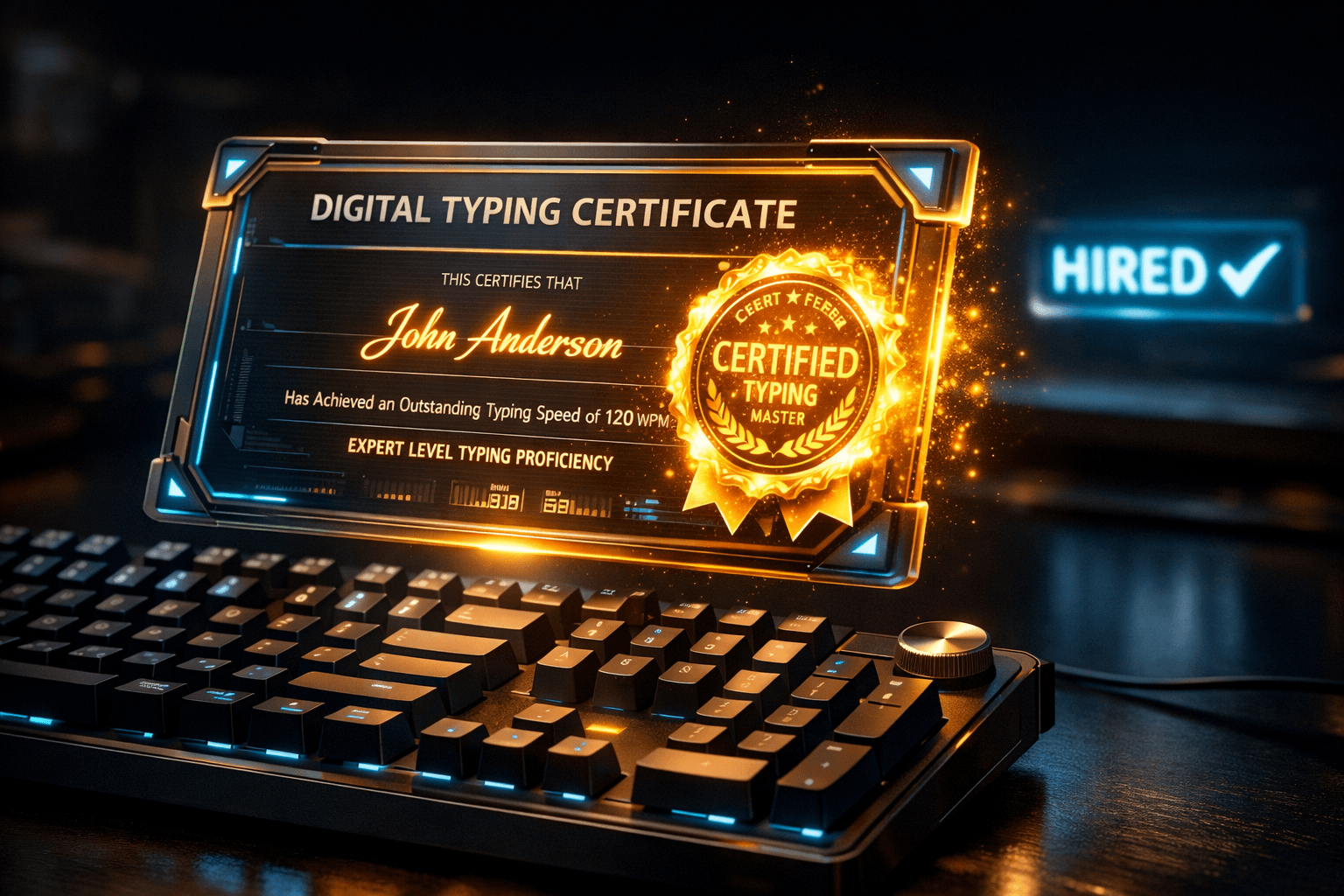
I downloaded the certificate that same afternoon. Seeing a specific, verified number — not a self-estimate, not a vague claim, but a tested and recorded result — felt genuinely different from anything I had put on my resume before.
What Changed in My Applications
I added one precise line to my resume Skills section:
*"Typing Speed: 64 WPM / 96% Accuracy — Verified (Typingverified Certificate, 2026)"*
I also attached the certificate as an additional document wherever the application system allowed it, and I linked to it directly in my email cover letters with a single sentence: "My typing speed of 64 WPM at 96% accuracy is independently verified — certificate attached."
The difference was immediate and measurable. Within two weeks I had received three interview requests. In the two months before I earned the certificate, I had received one. Two of those three interviewers specifically mentioned the certificate during our initial calls — one said it was what caused them to move my application to the shortlist, because most candidates they saw only self-reported without any verification.
The most memorable response came from a recruiter who said, almost matter-of-factly: "We usually ask candidates to complete a typing assessment during the process. Your certificate tells us what we need to know, so we're going to skip that step." That moment clarified exactly what the certificate was doing: it was answering a question the employer was going to ask anyway, before they had to ask it.
Why Third-Party Verification Works
It is easy to dismiss a credential you earn yourself in a few weeks as lightweight. But the value of the typing certificate is not that it proves you are exceptional — it is that it proves you are real. In a market full of self-reported numbers, a tested, independently recorded score does something none of those self-reports can do: it removes uncertainty.
A recruiter who sees "60 WPM" on a resume has to decide whether to trust that number. A recruiter who sees "64 WPM, 96% accuracy, verified" can simply use that number. One of those requires a judgment call under time pressure; the other does not. In a high-volume screening process, reducing friction for the recruiter is how you get called.
There is also a secondary signal the certificate sends: that you took the role seriously enough to prepare before applying, and that you are the kind of person who seeks independent verification of their own claims rather than just hoping no one checks. Hiring managers notice that. Not every candidate who meets the WPM bar behaves that way.
The Outcome
I accepted a fully remote data entry coordinator role four weeks after submitting my first certificate-backed application. The role pays better than the in-office equivalent would have, offers complete schedule flexibility, and comes with the kind of autonomy that only remote roles tend to provide. It would have been an extremely difficult role to land from a pool of 200+ applicants without something concrete to separate my application.
The certificate did not get me the job on its own — the interview still had to go well, and the offer still required negotiation. But it got me into the interview. It was the thing that moved my application from the undifferentiated pile into the shortlist. In a competitive remote job market, that single step is often the entire difference.
If you are applying for remote roles that require any level of typing speed and you are still self-reporting without verification, the gap between where you are and where you need to be is almost certainly smaller than it feels. Three weeks of focused practice is a very short period of time relative to how long a job search can drag on without traction.
About the author
Louis
Louis is a developer and productivity tools creator who built Typingverified to help professionals build verifiable typing skills. He writes about typing techniques, productivity, and keyboard ergonomics based on hands-on testing and research.
Email: support@typingverified.com
More articles
The Complete Beginner's Guide to Touch Typing in 2026 (Start to Certificate)
Everything you need to know about learning touch typing in 2026, from your first home-row practice to earning a professional typing certificate.
Typing Wrist Pain: What Causes It and How to Type Without Hurting Yourself
Wrist pain from typing is preventable. Learn the real causes of typing-related wrist pain and the setup, technique, and stretching fixes that actually work.
30 Typing Practice Sentences That Will Improve Your WPM Fast
Looking for typing practice sentences that actually improve your speed? Here are 30 carefully chosen sentences targeting accuracy, speed, and common word patterns.