10 Remote Jobs Hiring Right Now That Require Fast Typing (2026)
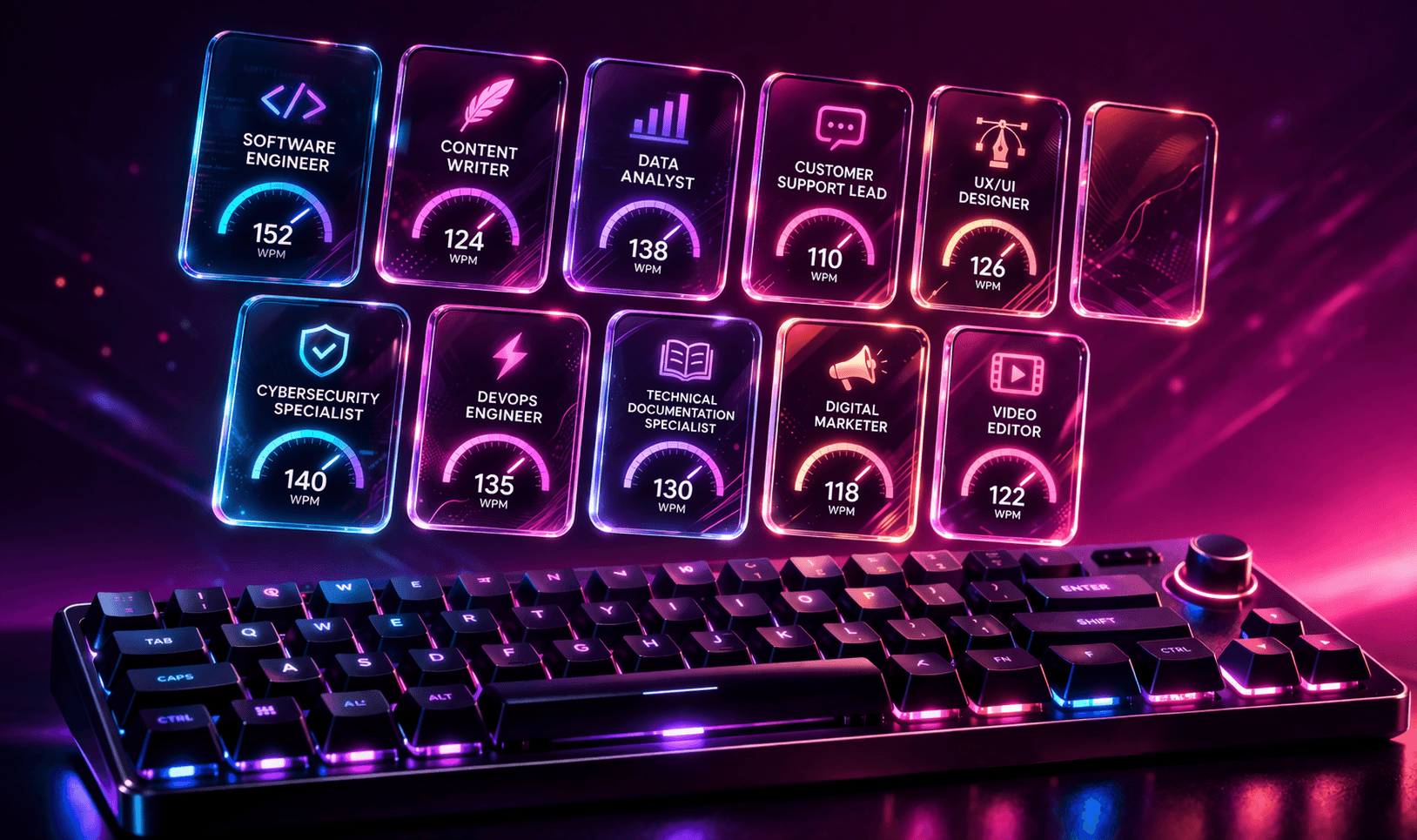
If you can type fast and accurately, you have a marketable skill that is in high demand right now. Remote employers across multiple industries are actively hiring for typing-intensive roles — and many of them do not require a degree, years of experience, or specialized training to get started.
What they do require is demonstrated competence. In a market where hundreds of candidates apply for the same remote listing, the ones who move forward tend to be the ones who can prove their typing ability with something more concrete than a self-reported number. That is where a verified certificate becomes genuinely useful.
Here are 10 legitimate remote jobs in 2026 that put your typing speed to work — along with what employers actually expect and how to position yourself competitively.
1. Data Entry Specialist
Required WPM: 45–65 | Average Salary: $32,000–$52,000/year
Data entry specialists input, verify, and manage information across databases, spreadsheets, and internal systems. It is one of the most common entry-level remote roles and consistently the first job people land using a typing certificate. Volume hiring means openings are frequent, but competition is high — verified speed is one of the clearest ways to separate your application from the pile.
2. Medical Transcriptionist
Required WPM: 65–85 | Average Salary: $35,000–$60,000/year
Medical transcriptionists convert physician voice recordings into written patient records. The role demands both speed and familiarity with medical terminology — errors in patient documentation carry real consequences. Many positions are fully remote with flexible hours, and experienced transcriptionists often command the higher end of the salary range. This is one of the roles where the typing requirement is not just a filter but a daily performance baseline.
3. Legal Transcriptionist
Required WPM: 60–80 | Average Salary: $40,000–$65,000/year
Legal transcriptionists document court proceedings, depositions, and legal dictation. Accuracy is critical — a single error in a legal record can have serious consequences. Most employers in this space test applicants during screening, so having a certified baseline before you apply removes one barrier and signals that you take accuracy seriously.
4. Remote Customer Service Representative (Live Chat)
Required WPM: 40–55 | Average Salary: $30,000–$48,000/year
Live chat support roles require you to type responses to customers in real time while navigating multiple systems simultaneously. Speed matters here, but so does composure: the ability to produce clear, accurate output under pressure is exactly what live chat environments demand. Many chat support roles now operate in a fully asynchronous or shift-based model, making them accessible across time zones.
5. Freelance Transcriptionist
Required WPM: 60–75 | Earnings: $0.45–$1.50 per audio minute
Freelance transcription via platforms like Rev and TranscribeMe gives you complete schedule flexibility. You choose your hours and workload. Income scales directly with typing speed — a transcriptionist at 70 WPM earns meaningfully more per hour than one at 50 WPM on the same audio file. It is one of the few remote roles where improving your speed has an immediate, linear effect on your take-home pay.
6. Virtual Assistant
Required WPM: 45–60 | Average Salary: $35,000–$55,000/year
Virtual assistants handle emails, scheduling, document preparation, research, and communication on behalf of executives and business owners. Fast, accurate typing is one of the core competencies clients screen for — not because it is listed in every job description, but because slow typists create friction in the workflows VAs are hired to streamline. Including a verified typing certificate in a VA proposal or application signals reliability before the first task.
7. AI Training Data Specialist
Required WPM: 45–65 | Average Salary: $38,000–$58,000/year
This is one of the fastest-growing remote roles of 2026. AI companies need humans to type, annotate, label, and verify large volumes of text data used to train language models. The work is repetitive by nature, but demand is high and growing, the barrier to entry is relatively low, and the roles are increasingly available on both contract and full-time bases. Typing speed directly affects how much work you can complete per shift.
8. Captioner / Live Scribe
Required WPM: 80–100+ | Average Salary: $45,000–$75,000/year
Captioners add real-time subtitles to live video streams, events, and broadcasts. It requires very high speed and near-perfect accuracy — there is no opportunity to go back and correct. CART (Communication Access Realtime Translation) captioners, who provide real-time captions for deaf and hard-of-hearing individuals, are especially well compensated. This is a high-bar role that rewards significant investment in typing skill development.
9. Remote Administrative Assistant
Required WPM: 45–60 | Average Salary: $34,000–$52,000/year
Administrative assistants at remote companies handle correspondence, scheduling, document creation, and office coordination — all done via keyboard. Most roles now operate fully remotely, and many organizations prefer candidates who have already demonstrated their digital workplace competency rather than those who require onboarding to validate it. A typing certificate is a small but concrete signal of that readiness.
10. Freelance Writer / Content Creator
Required WPM: 60–80 recommended | Earnings: $0.03–$0.30 per word or $30–$150/hour
Fast typists produce more content per hour, which directly increases their earning rate as freelance writers. A writer producing 500 words per hour and one producing 900 words per hour are not just different in speed — they have fundamentally different economics. For content writers paid per word or per piece, typing speed is a leverage point that compounds over the course of every working day.
What Most of These Roles Have in Common
Almost every remote job on this list will ask you to complete a typing test at some point in the hiring process. Some will ask at the application stage; others will ask during or after the first interview. A smaller but growing number will accept a verified typing certificate in place of — or alongside — the live test.
The practical implication is straightforward: knowing your actual verified WPM before you apply puts you in a much stronger position. You can filter for roles where you meet the requirement, state your speed with confidence on applications, and avoid being disqualified at the assessment stage after investing time in the interview process.
How to Position Yourself for These Roles
The candidates who consistently move from application to interview in high-volume remote hiring are not necessarily the fastest typists. They are the candidates who make it easiest for a recruiter to say yes. A verified certificate, attached directly to your application or linked in your cover letter, answers the question the recruiter would have asked anyway — and does it before screening even begins.
If you are not yet at the WPM threshold for the role you want, the gap is almost certainly smaller than it feels. Most people reach a meaningful improvement in speed and accuracy within two to three weeks of structured daily practice.
About the author
Louis
Louis is a developer and productivity tools creator who built Typingverified to help professionals build verifiable typing skills. He writes about typing techniques, productivity, and keyboard ergonomics based on hands-on testing and research.
Email: support@typingverified.com
More articles
The Complete Beginner's Guide to Touch Typing in 2026 (Start to Certificate)
Everything you need to know about learning touch typing in 2026, from your first home-row practice to earning a professional typing certificate.
Typing Wrist Pain: What Causes It and How to Type Without Hurting Yourself
Wrist pain from typing is preventable. Learn the real causes of typing-related wrist pain and the setup, technique, and stretching fixes that actually work.
30 Typing Practice Sentences That Will Improve Your WPM Fast
Looking for typing practice sentences that actually improve your speed? Here are 30 carefully chosen sentences targeting accuracy, speed, and common word patterns.