
Legal Typist vs Court Reporter: Which Career Pays More?
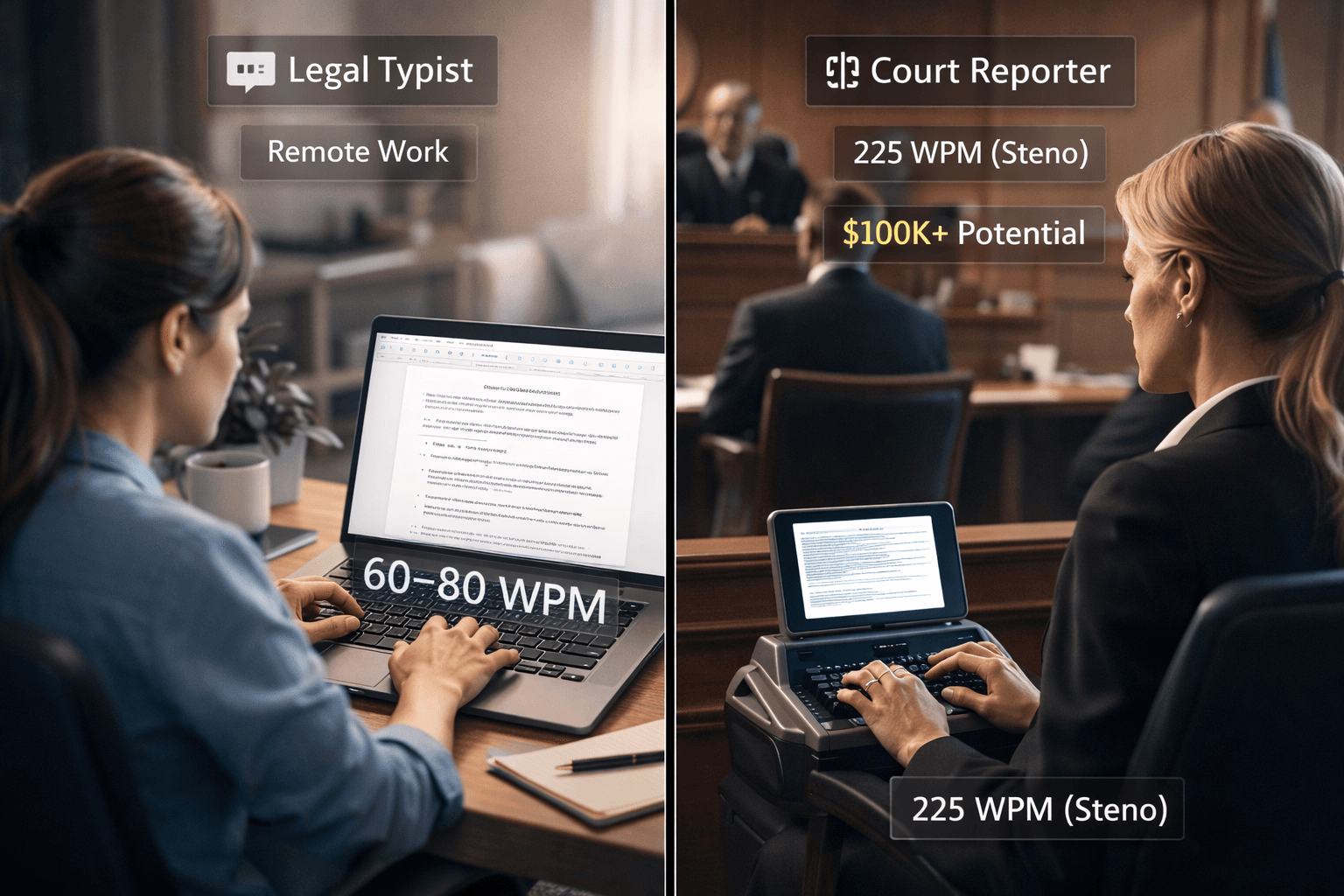
If you are interested in a typing career in the legal field, you have two distinct paths: legal typist (often overlapping with legal transcription work) and court reporter. Both are in demand, both can pay well, and both reward fast, accurate text production — but they are not interchangeable. The short answer to "which pays more?" is usually court reporting at the top end, because certification, real-time responsibility, and stenographic skill are harder to replace. Legal typing and transcription can still be an excellent income with a much faster entry and strong remote flexibility, especially if you specialize.
This article is a practical comparison of pay, training, and day-to-day work — not legal career advice for your specific jurisdiction.
Who gets paid more, and why?
Court reporters typically earn higher median and peak compensation than most legal typists because the job is narrowly licensed, standardized through testing, and tied to official proceedings where accuracy and availability command a premium. Experienced reporters in busy markets can reach six-figure ranges that are uncommon for general legal typing roles.
Legal typists / transcriptionists more often compete on throughput, turnaround time, and familiarity with legal formatting and terminology. Pay can be very solid, but the ceiling is usually lower than specialized court reporting unless you build a strong freelance practice, niche specialty, or move into operations leadership.
Salaries vary widely by city, employer type, union or contract coverage, experience, and whether you are W-2 or 1099. Treat numbers below as illustrative U.S.-style ranges for planning — verify local job postings and credential requirements where you live.
Legal typist / legal transcriptionist: what the work actually looks like
What they do: Legal typists and legal transcriptionists turn recordings and dictation into usable text — hearings, depositions, attorney dictation, client letters, motions, and internal notes. Work may be verbatim or clean-read, depending on client rules. Some roles emphasize formatting (court style, caption lines, exhibit references). Others emphasize raw speed and consistent deadlines.
Where the pressure shows up: Turnaround windows and revision cycles. Accuracy matters, but the emotional "heat" is often deadline-driven: a long file due Monday morning, or same-day rough drafts for a busy partner.
Typical clients / employers: law firms, court reporting agencies (as an overflow typist), legal services vendors, and independent attorneys outsourcing overflow work.
Required typing speed: Many employers want roughly 60–80 WPM with 98%+ accuracy on professional text, though freelance volume work can reward even higher sustained speed.
Average salary (illustrative): roughly $40,000–$65,000/year for remote-friendly roles in many markets, with higher amounts possible in major metros or with strong freelance rates.
Training required: No universal credential, but legal terminology, citation norms, and deposition formatting are real differentiators. Short courses, practice in the specific templates your market uses, and a portfolio of cleaned samples help you win work faster.
Work environment: Often remote with flexible schedules, especially for asynchronous transcription. Some hybrid setups exist inside firms.
Court reporter: what the work actually looks like
What they do: Court reporters produce the official verbatim record for trials, hearings, and depositions — commonly capturing speech in real time using stenotype, not a traditional QWERTY typing competition score. Your output becomes evidence-grade documentation.
Where the pressure shows up: Real-time fidelity under procedural conditions — names spelled correctly, speakers identified, objections and read-ons handled cleanly. Missing a line matters differently than missing a comma in a rough draft.
Required speed: Certification paths frequently reference high steno speeds; 225 WPM in steno is commonly cited as a certification benchmark. Comparing steno to raw QWERTY WPM is imperfect, but think "elite text capture skill," not "good office typing."
Average salary (illustrative): commonly cited ranges like $60,000–$100,000+, with top performers in high-demand markets reaching $150,000+ depending on workload and specialty.
Training required: typically 2–4 years of formal court reporting education plus passing credential exams. The NCRA Registered Professional Reporter (RPR) credential is a familiar standard in many U.S. contexts.
Work environment: historically in-person courtrooms, with more remote deposition options via videoconference in many markets. Schedules can be less flexible than async transcription because you follow the calendar of courts and counsel.
Pay drivers that move the numbers (both paths)
- Geography: big cities and busy litigation hubs usually pay more — and cost more to live in.
- Employment model: W-2 stability versus freelance upside and volatility.
- Specialty: complex litigation, realtime delivery, and expedited turnaround can command premium rates.
- Experience: speed alone is not enough — reliability and clean output reduce rework.
If you are benchmarking pay, look at local job postings and ask agencies what they pay for "turnaround" versus "rough draft" versus "final-ready."
Career trajectory: realistic progression
Legal typing / transcription: start with general transcription speed, add legal formatting skills, then specialize (depositions, appeals, malpractice, family law, etc.). Some people expand into scoping, proofing teams, or vendor account management.
Court reporting: invest in certification, build speed and dictionary depth, then grow through dense litigation markets, realtime skills, and repeat counsel relationships.
Misconceptions that trip people up
A common mistake is treating "legal transcription" and "court reporting" as interchangeable titles on a job board. They can overlap in the sense that both produce legal text, but court reporting is a credential-driven profession oriented around certified, official transcripts — not general document typing.
Another misunderstanding is that stenography is simply "very fast QWERTY." Steno is a different machine and theory with a long training runway. That is precisely why experienced reporters can defend higher rates: clients are buying a standardized skill with supply constraints.
People also sometimes confuse these roles with paralegal work. Paralegals may type often, but their core value is case support and legal tasks under attorney supervision. Legal typists and reporters are primarily production professionals measured on output quality and speed.
Finally, remember that tools and workflows change. Accuracy, confidentiality discipline, and deadline reliability remain the transferable advantages — no matter which path you pick.
If you are comparing offers across countries, treat credential names and salary tables as starting research, then confirm details with employers, schools, and professional associations in your jurisdiction.
Side-by-Side Comparison
| Factor | Legal Typist | Court Reporter |
|---|---|---|
| Starting salary | $38,000–$50,000 | $50,000–$65,000 |
| Peak salary | $65,000 | $100,000–$150,000+ |
| Training time | Weeks to months | 2–4 years |
| Certification required | No | Yes (RPR) |
| Equipment | Standard keyboard | Stenotype machine |
| Work style | Mostly remote, flexible | Mostly in-person, scheduled |
A simple decision checklist
Ask yourself:
- Timeline: do you need income in weeks/months, or can you invest years?
- Tolerance for in-person court scheduling versus preferring async remote work?
- Income goal: do you want "strong professional earnings with flexibility" or "maximize long-term earning power in a licensed niche"?
- Equipment appetite: standard keyboard practice versus steno machine training?
- Risk tolerance: freelance variability versus structured employment?
Which should you choose?
If you want to enter the legal typing ecosystem quickly with skills you can build now — touch typing, accuracy, templates, terminology — legal transcription and legal typing is typically the faster, lower-barrier path, with excellent remote options depending on your market.
If you are willing to invest years in formal training and certification, court reporting often offers higher long-term upside and a harder-to-automate professional niche — with different lifestyle tradeoffs.
Either way, verified speed and accuracy helps you stand out when firms compare candidates. Build a credential that matches what you claim on paper, then keep training like your paycheck depends on it — because it does.
About the author
Louis
Louis is a developer and productivity tools creator who built Typingverified to help professionals build verifiable typing skills. He writes about typing techniques, productivity, and keyboard ergonomics based on hands-on testing and research.
Email: support@typingverified.com
More articles
The Complete Beginner's Guide to Touch Typing in 2026 (Start to Certificate)
Everything you need to know about learning touch typing in 2026, from your first home-row practice to earning a professional typing certificate.
Typing Wrist Pain: What Causes It and How to Type Without Hurting Yourself
Wrist pain from typing is preventable. Learn the real causes of typing-related wrist pain and the setup, technique, and stretching fixes that actually work.
30 Typing Practice Sentences That Will Improve Your WPM Fast
Looking for typing practice sentences that actually improve your speed? Here are 30 carefully chosen sentences targeting accuracy, speed, and common word patterns.