
Is a Typing Certificate Worth It? Here's What Employers Actually Say
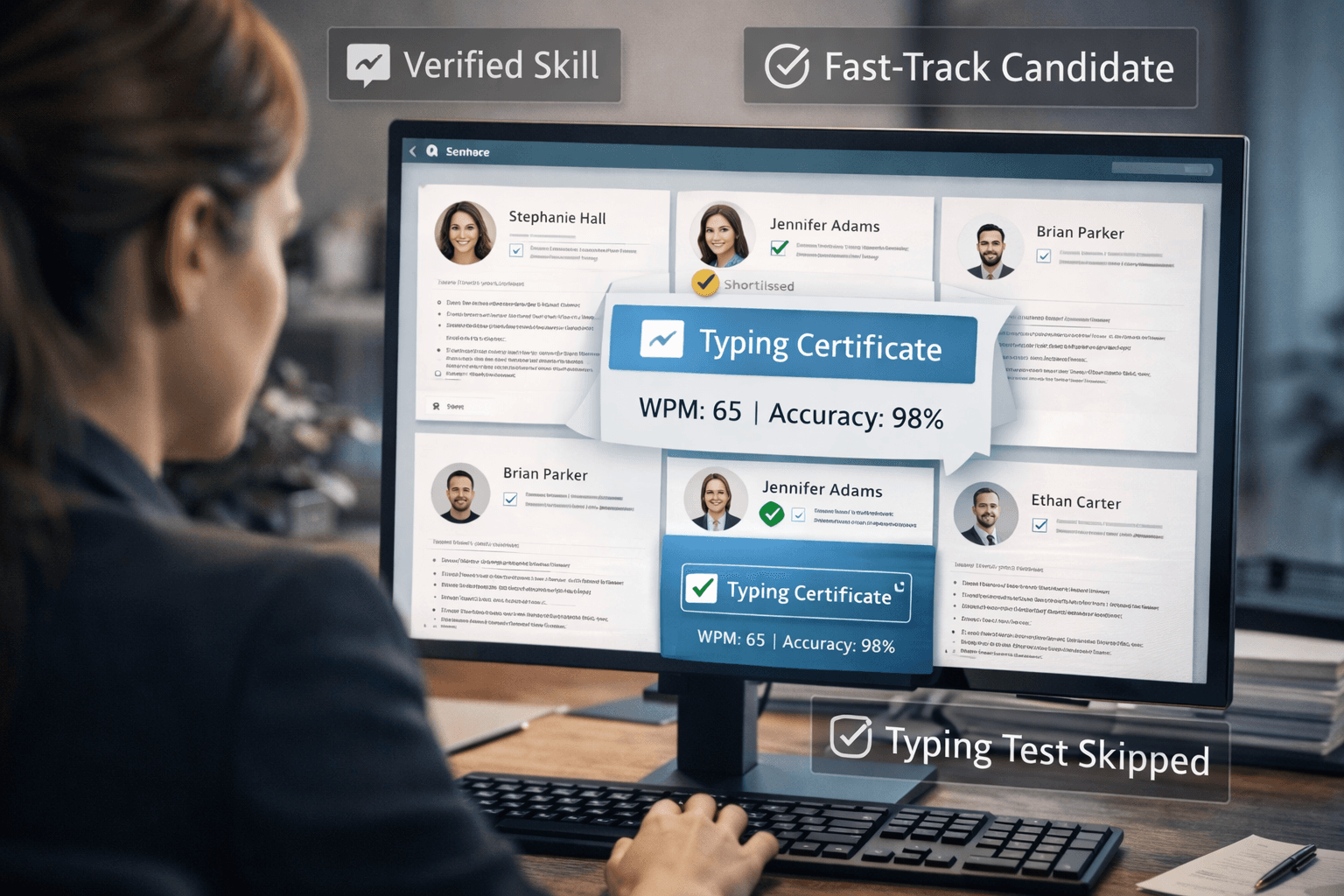
If you are investing real time into typing practice, this is the question that matters: is a typing certificate actually useful in hiring, or is it just another badge nobody reads?
The short answer is this: a typing certificate is worth it when typing speed and accuracy are part of how your job performance will be judged. In those roles, a certificate can move your application forward faster. In roles where typing is not a core output, it is a minor plus at best.
The better answer is more practical, so let us break down what employers actually care about and when a certificate helps you win interviews.
What Employers Actually Mean When They Ask for Typing Speed
Most employers are not obsessed with your number for its own sake. They care because typing speed and accuracy are proxy signals for on-the-job throughput.
If a support team handles 80 live chats per day, a 15 to 20 WPM difference can affect queue times. If a data entry team processes invoices, a high-error typist creates correction work that slows everyone else down. If a legal assistant drafts documents all day, slower typing directly increases turnaround time.
So when a job post says "60 WPM required," it usually means:
- the team has production volume targets
- managers need workers who can ramp quickly
- hiring teams need a simple screening metric to compare candidates
In that context, typing speed is not random. It is operational.
What Employers Say About Certificates
In interviews with recruiters and hiring managers across admin, support, and operations roles, three themes come up repeatedly.
"It removes friction from screening." Running live typing tests for every shortlisted candidate is time-consuming. If your certificate is credible and recent, some employers will skip the first typing screen or shorten it.
"It proves the resume claim." Anyone can type "72 WPM" on a resume. A certificate with a stated speed and accuracy makes that claim verifiable and therefore more trustworthy.
"It signals preparation." Candidates who show up with proof of skill look intentional. Even when two applicants have similar experience, the one who prepared objective proof often appears more serious.
This does not guarantee a job offer. It does reduce uncertainty, and hiring teams like lower-risk decisions.
Where a Typing Certificate Has the Highest ROI
The value of a certificate is not equal across all jobs. It is strongest where keyboard output is a daily core task.
1) Data Entry and Back-Office Operations
These teams are measured on volume, accuracy, and turnaround. Managers need people who can work consistently without introducing costly errors. A certificate helps because it gives a baseline before onboarding.
Typical use case: a hiring lead has 40 applicants for 3 seats. Applicants with documented speed and accuracy are easier to prioritize for interview slots.
2) Medical, Legal, and General Transcription
In transcription workflows, speed without accuracy is not useful. Employers care about both. A certificate that includes accuracy percentage is more persuasive than WPM alone.
Typical use case: a candidate can demonstrate they are fast enough for production and accurate enough to avoid heavy edit passes.
3) Remote Customer Support (Chat-Heavy Roles)
In live chat support, response latency affects customer satisfaction scores. Faster typing supports better multitasking across simultaneous conversations.
Typical use case: support managers use a certificate as an early confidence signal, then validate with scenario-based training or roleplay.
4) Administrative and Executive Assistant Roles
Assistants draft emails, notes, summaries, and documents at high frequency. Typing efficiency directly affects how quickly leaders get output.
Typical use case: when candidates have similar software familiarity, verified typing performance can be a practical tie-breaker.
5) Staffing Agencies and Temp Placements
Agencies place candidates quickly and repeatedly. Standardized proof is useful because it reduces back-and-forth with clients and speeds matching.
Typical use case: agencies keep certificate-backed profiles ready for immediate dispatch when urgent requests arrive.
When a Certificate Matters Less
A certificate is not universally important. In many roles, it has limited influence.
- software engineering roles evaluated mainly on coding and architecture
- design, strategy, or leadership roles where communication quality matters more than typing rate
- sales roles where relationship outcomes dominate
- highly specialized technical jobs where domain knowledge outweighs general admin throughput
In these cases, include typing proof only if it supports a broader operational profile. Do not let it become the headline.
When a Certificate Can Hurt Your Candidacy
Yes, this can happen.
If your certificate score does not represent your current real-world ability, it creates credibility risk. For example, claiming 70 WPM but delivering 48 WPM in a live task can trigger immediate doubt about other self-reported skills.
It can also hurt if the score is outdated. Someone who tested one year ago but has not practiced may underperform under pressure. Employers care about current, repeatable performance, not your personal best from months ago.
Finally, using a certificate to compensate for obvious gaps in required experience can backfire. It is a supporting signal, not a replacement for role fit.
How to Use a Certificate Effectively in Hiring
Most candidates underuse their certificate. The goal is not to "have" one. The goal is to deploy it at the right moments.
Resume Placement
Place typing proof in your Skills or Additional Qualifications section, and keep it specific:
Typing Speed: 68 WPM, 97% accuracy (Verified certificate)
Avoid vague lines like "fast typer." Precision reads as credibility.
Job Application Fields
If an application asks for speed, provide the number and mention verification in the same line. If attachments are allowed, include the certificate or a link.
Interview Talking Point
Use a short script that ties your metric to the role:
"I type at 68 WPM with 97% accuracy, and I can comfortably meet your stated 60 WPM requirement in chat-heavy workflows."
This reframes typing from trivia into job relevance.
A Practical Pre-Application Checklist
Before applying to roles that mention typing requirements, use this checklist:
- Match the role benchmark. Know the posted requirement (for example 50, 60, or 70 WPM).
- Retest under realistic conditions. Use timed tests with punctuation and minimal distractions.
- Track both speed and accuracy. Do not chase WPM by sacrificing quality.
- Get a fresh certificate. Recent proof is stronger than old proof.
- Align your resume claim with reality. Never advertise a number you cannot reproduce.
- Prepare one interview sentence. Explain how your typing performance supports the role's daily workload.
This process takes little time, but it can improve interview conversion rates because it removes avoidable doubt.
What Employers Actually Reward
At hiring time, employers reward reliability more than peak numbers. A consistent 62 WPM at high accuracy is often more valuable than a volatile 75 WPM with frequent mistakes.
That is why certificate + consistency is the winning combination:
- certificate provides evidence
- live performance confirms repeatability
- role examples demonstrate relevance
When all three align, your application feels low-risk and easy to advance.
The Bottom Line
A typing certificate is worth it when the job uses typing as a real performance lever and your certificate reflects your current, repeatable level. In that situation, it is one of the simplest high-ROI credentials you can add to your application stack.
It will not replace experience, communication skills, or domain knowledge. But it can absolutely help you pass screens faster, increase credibility, and stand out in crowded candidate pools.
About the author
Louis
Louis is a developer and productivity tools creator who built Typingverified to help professionals build verifiable typing skills. He writes about typing techniques, productivity, and keyboard ergonomics based on hands-on testing and research.
Email: support@typingverified.com
More articles
The Complete Beginner's Guide to Touch Typing in 2026 (Start to Certificate)
Everything you need to know about learning touch typing in 2026, from your first home-row practice to earning a professional typing certificate.
Typing Wrist Pain: What Causes It and How to Type Without Hurting Yourself
Wrist pain from typing is preventable. Learn the real causes of typing-related wrist pain and the setup, technique, and stretching fixes that actually work.
30 Typing Practice Sentences That Will Improve Your WPM Fast
Looking for typing practice sentences that actually improve your speed? Here are 30 carefully chosen sentences targeting accuracy, speed, and common word patterns.