
How to Earn a Typing Certificate (And Why It's Worth It)
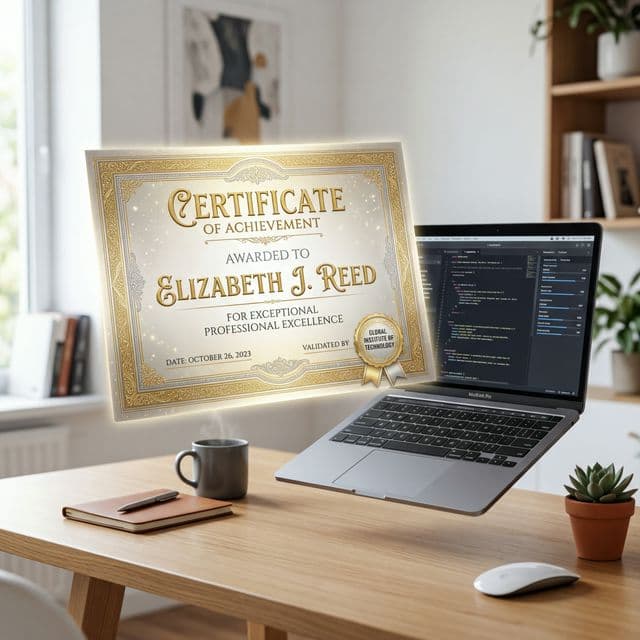
A typing certificate is a practical proof-of-skill document. It shows employers, clients, or training programs that you can type at a verified speed with a verified level of accuracy. In a competitive job market — particularly for remote roles where hundreds of candidates apply for the same position — that simple proof can help your application stand out faster than a generic "fast typist" claim on a resume ever could.
For many roles, typing is not a bonus skill. It is a daily productivity driver that shapes how much you can accomplish in a workday. A certificate helps hiring teams trust that you can perform from day one, without the overhead of a live test or follow-up assessment.
Who Benefits Most from a Typing Certificate
Typing certificates are especially useful for a specific set of job seekers and professionals. If you are applying to admin, support, operations, data entry, or transcription roles, a certificate is one of the most direct ways to signal that you meet the technical baseline before the recruiter has to ask.
Students who want to demonstrate digital workplace readiness, freelancers and virtual assistants building credibility in their proposals, and career switchers looking for measurable milestones that validate their skills all benefit from the same thing: a concrete, testable number that replaces vague self-reporting.
Even if a role does not formally require certification, attaching one can shorten screening time. Recruiters in high-volume hiring situations are looking for reasons to move applications forward quickly. A verified typing credential removes one obstacle between your resume and the shortlist.
Why Employers Actually Care
Hiring teams often receive dozens or hundreds of similar applications. Nearly every candidate claims to be a fast typist. A certificate helps answer key questions quickly: Can this person work efficiently in text-heavy workflows? Can they maintain quality under time pressure? Are they proactive enough to develop and validate their own skills before being asked?
When a hiring manager sees documented speed and accuracy — not a self-estimate but a tested, recorded result — they have one less uncertainty to investigate. That reduction in friction matters most during high-volume screening, when the difference between a call-back and a pass often comes down to which application required the least effort to evaluate.
There is also a secondary signal that a certificate sends about the candidate's work ethic. Earning a certificate takes structured effort. Submitting it says: I prepared before applying, and I can back up what I claim.
What You Need to Earn a Certificate on Typingverified
To unlock your official Typingverified certificate, you must complete the full learning and performance path. This involves two stages.
First, you complete all 10 structured lessons. Each lesson has a specific accuracy and speed threshold you must clear before advancing. You cannot skip the uncomfortable lessons by rushing; the structure requires you to demonstrate real competence at each stage before moving on.
Second, you pass the final 60-second test while logged in, targeting at least 35 WPM net speed with 95% accuracy in a single run. Net WPM — your gross speed minus a deduction for uncorrected errors — is what most employers record, so this is what the certificate reflects.
After completion, you can generate and download your certificate immediately. The result is a specific, verified number: not a self-assessment but a tested and documented performance.
Step-by-Step Preparation Plan
If you want to earn your certificate efficiently, a structured approach gets you there faster than unplanned practice. Start by establishing your baseline. Take a timed test and record your net WPM and accuracy honestly — this is your actual starting point, not the number you wish you were at.
From there, run focused daily sessions of 15 to 20 minutes. Consistency beats marathon sessions. Daily short sessions build muscle memory more effectively than occasional long ones because the motor patterns have time to consolidate between sessions.
Train your weak keys intentionally rather than only practicing what already feels easy. If your error rate spikes on certain letter combinations or rows, target those specifically. Reviewing your error patterns after each session is what separates candidates who plateau from candidates who keep improving.
Simulate final-test pressure regularly: use full timed runs in a distraction-free environment so that the conditions of the actual certification test feel familiar rather than stressful. Candidates who have practiced under pressure consistently outperform candidates who practiced in relaxed conditions.
Common Mistakes That Delay Certification
Many learners take longer than necessary to earn their certificate because they chase speed before accuracy is stable. High error rates drag down net WPM and make scores inconsistent — the opposite of what a certificate is supposed to demonstrate. Prioritize clean output first, then scale speed once your accuracy floor is solid.
Other common delays: skipping lesson rigor and jumping straight to the final test, practicing irregularly (gaps of several days disrupt muscle memory), ignoring posture and hand tension (which causes fatigue that compounds into errors), and failing to review error patterns after sessions. Each of these is fixable with a small adjustment in approach.
How to Use Your Certificate Professionally
A certificate is most effective when placed strategically rather than buried or omitted. Add a precise line to your resume's Skills section: the specific WPM figure, accuracy percentage, and the note "verified." Link the certificate in your LinkedIn profile and freelance portfolio. Mention it in cover letters with a single concrete sentence rather than a vague reference.
Pairing your certificate with context works better than just listing it: "Verified typing performance: 64 WPM at 96% accuracy — certificate attached" gives a recruiter a complete picture in one sentence. Attaching the actual certificate document wherever the application system allows it is worth the effort because it means the recruiter can check the result without having to trust you on it.
Certificate Plus Interview Strategy
If an employer still runs a live typing test during the process, your certificate helps both psychologically and practically. You already know your tested baseline, so there is no uncertainty about whether you can meet the requirement. You are familiar with timed conditions, which removes the anxiety of performing under a clock for the first time. You can pace confidently from the start rather than rushing through nerves.
Some employers will skip the live test entirely once they see a recent verified certificate. One recruiter's reaction captures this well: "Your certificate tells us what we need to know, so we're going to skip that step." That response reflects a pattern: the certificate answers the question the employer was going to ask before they have to ask it. That is how verified credentials save time for both sides.
How Often Should You Retest and Update?
Treat your typing certificate like a living credential rather than a one-time achievement. If you are actively job searching, re-test every six to twelve weeks and update your certificate when your net WPM improves meaningfully. Typing speed does change — it tends to improve with consistent use and can slip slightly during periods of inactivity.
Keeping your certificate current means your application materials remain credible. A certificate dated from several years ago is less persuasive than one from the past few months. When in doubt, a fresh test takes less than five minutes and costs nothing.
Final Takeaway
A typing certificate is valuable because it turns a common claim into verified evidence. It helps employers trust your productivity before an interview begins, gives you a concrete and measurable target to work toward, and builds the kind of confidence that translates into stronger performance in both interviews and real work.
If you are ready to earn yours, the path is straightforward: establish your baseline, work through the structured lessons consistently, and complete the final test. The credential you earn is one of the simplest high-ROI additions you can make to a job application.
About the author
Louis
Louis is a developer and productivity tools creator who built Typingverified to help professionals build verifiable typing skills. He writes about typing techniques, productivity, and keyboard ergonomics based on hands-on testing and research.
Email: support@typingverified.com
More articles
The Complete Beginner's Guide to Touch Typing in 2026 (Start to Certificate)
Everything you need to know about learning touch typing in 2026, from your first home-row practice to earning a professional typing certificate.
Typing Wrist Pain: What Causes It and How to Type Without Hurting Yourself
Wrist pain from typing is preventable. Learn the real causes of typing-related wrist pain and the setup, technique, and stretching fixes that actually work.
30 Typing Practice Sentences That Will Improve Your WPM Fast
Looking for typing practice sentences that actually improve your speed? Here are 30 carefully chosen sentences targeting accuracy, speed, and common word patterns.